Balance Sheet Reconciliation Checklist: 8 Steps to a Reliable Month-End Close
The TallyScan Team
26 min read
#balance sheet reconciliation checklist#financial close process#month end reconciliation#accounting best practices#finance automation#balance sheet accounts reconciliation#month end close checklist#accounts receivable reconciliation#bank reconciliation checklist#balance sheet audit#automated reconciliation#financial close automation
The month-end close is where financial reality meets financial reporting. Done well, it gives leadership a clear and trustworthy picture of the business. Done poorly, it produces numbers that look credible but do not actually reflect what happened — and those inaccuracies compound quietly until they surface at the worst possible time: during an audit, a fundraise, or a board meeting where someone asks a question the CFO cannot confidently answer.
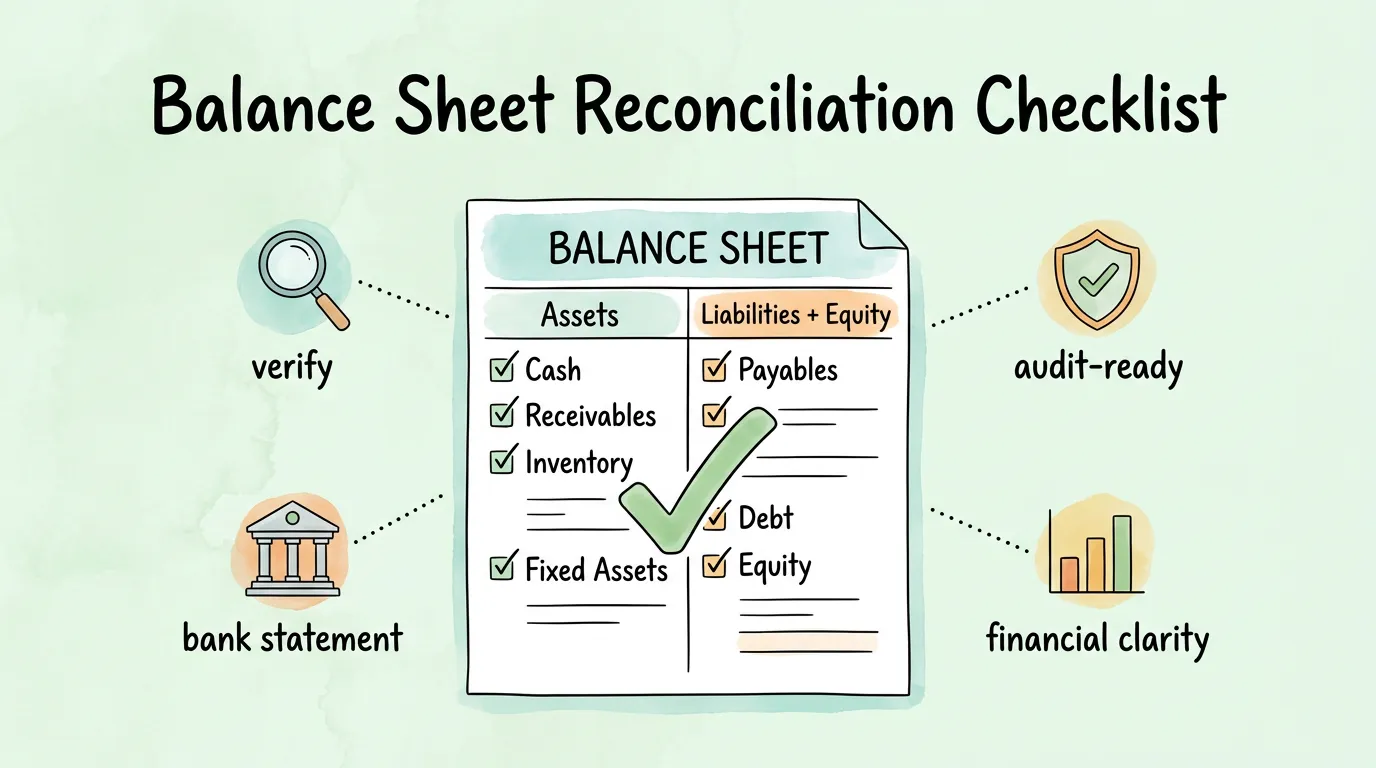
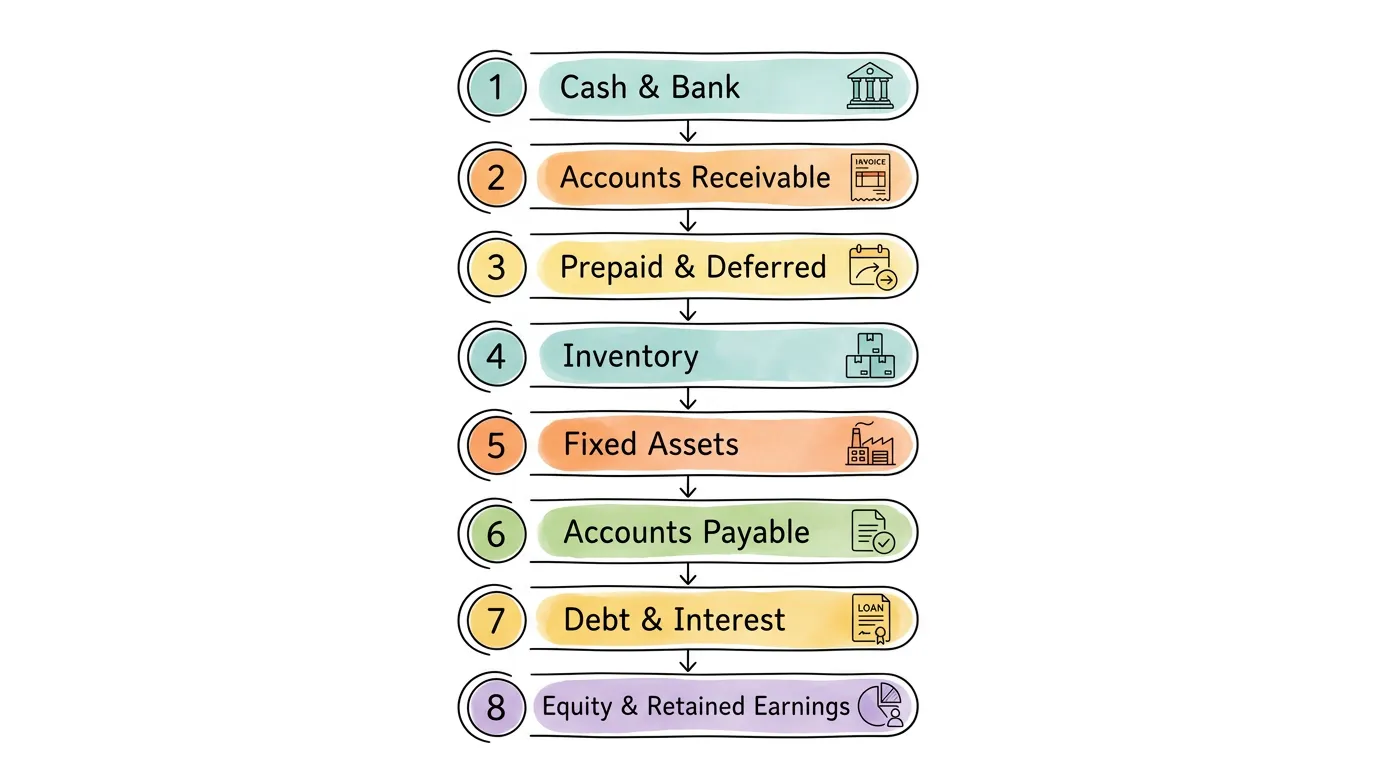
A balance sheet reconciliation checklist is the structured process that closes the gap between those two outcomes. It is the systematic verification that every account on your balance sheet is supported by documentation, that the numbers match their source records, and that any differences are identified, explained, and resolved. Below you'll find all eight account categories broken down step by step: what to check, how often, and what the red flags look like, through to the automation layer that turns a multi-day scramble into a routine close.
What Is a Balance Sheet Reconciliation?
A balance sheet reconciliation is the process of verifying that the balance reported in each account on the balance sheet matches the underlying transactions, sub-ledgers, or external statements that support it. For each account, you confirm that:
The opening balance matches the prior period's closing balance
All transactions recorded during the period are supported by documentation
The closing balance matches the corresponding external record (bank statement, vendor statement, loan amortization schedule, etc.)
Any timing differences or reconciling items are identified and documented with an expected resolution date
The goal is not just numerical accuracy — it is auditability. Every balance should be traceable to source documents that an auditor, a lender, or a tax authority could verify independently. When that traceability exists for every account, your financial statements are reliable. When it does not, you are reporting numbers you cannot fully defend.
Balance sheet reconciliation is different from bank reconciliation (which is one specific step within it) and different from a trial balance review (which checks that debits equal credits but does not verify that the individual balances are correct).
How Often Should You Reconcile Each Account?
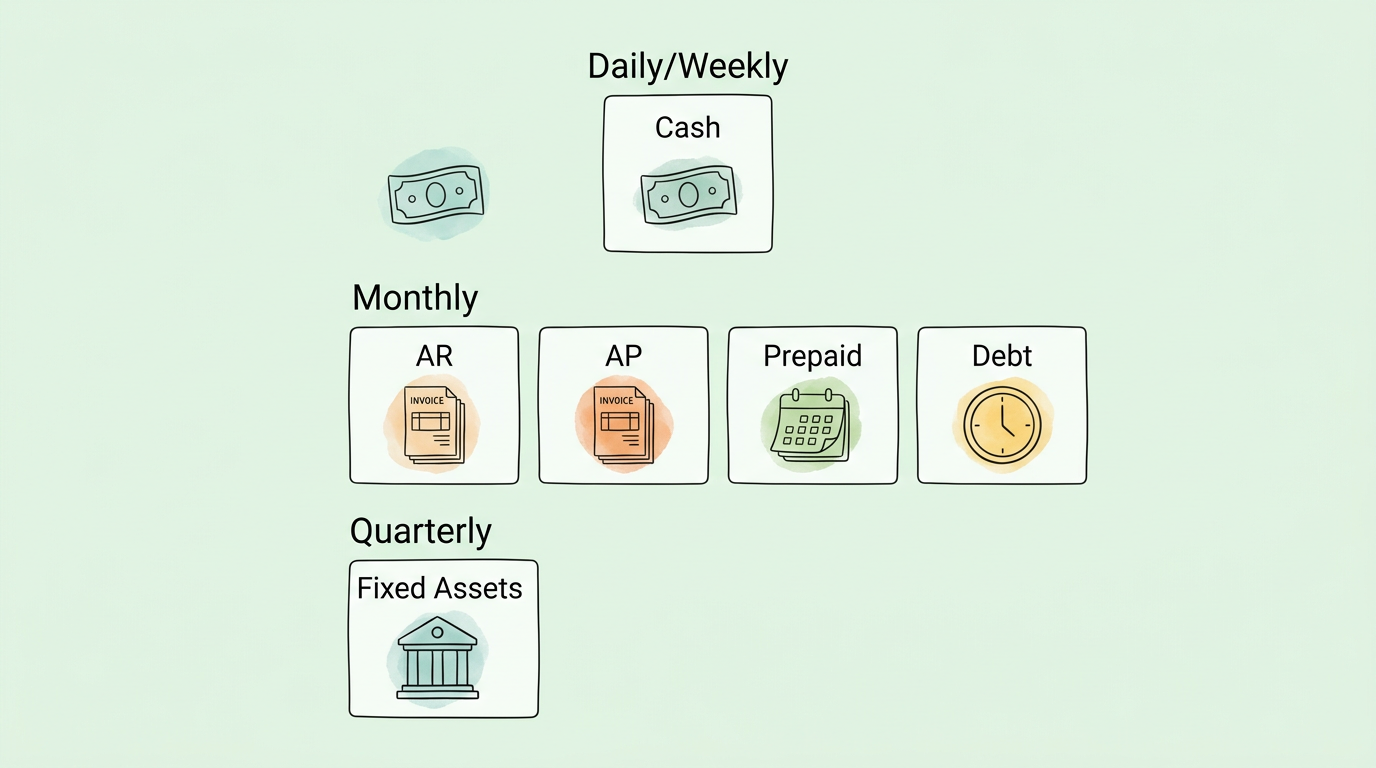
Not all balance sheet accounts carry equal risk or change with the same frequency. The reconciliation schedule should reflect both.
Account Category
Recommended Frequency
Risk if Skipped
Cash and bank accounts
Daily or weekly
Fraud, overdraft, misappropriation
Accounts receivable
Monthly (aging weekly)
Overstated assets, bad debt underestimation
Prepaid expenses
Monthly
Misstated expenses, overstated assets
Inventory
Monthly (cycle counts) + annual full count
Shrinkage, valuation errors, COGS misstatement
Fixed assets
Quarterly physical audit + monthly depreciation
Ghost assets, wrong depreciation, tax errors
Accounts payable
Monthly
Understated liabilities, duplicate payments
Accrued liabilities
Monthly (period-end)
Incomplete expense recognition
Debt and interest
Monthly
Covenant violations, interest misstatement
Equity and retained earnings
Monthly
Shareholder reporting errors, compliance issues
For businesses preparing audited financial statements, every account on the balance sheet requires formal monthly reconciliation. For smaller businesses, a tiered approach (daily for cash, monthly for most accounts, quarterly for fixed assets) achieves most of the benefit at a manageable workload.
What Does Each Step in the Balance Sheet Reconciliation Checklist Involve?
Step 1: Cash and Bank Account Verification
What it covers: All checking accounts, savings accounts, money market funds, petty cash, and restricted cash balances.
The reconciliation process:
Pull the bank statement for each account as of the period end date
Compare the bank's closing balance to the general ledger balance for each account
Identify timing differences:
Outstanding checks: issued by your company but not yet cleared the bank
Deposits in transit: recorded in your books but not yet posted by the bank
Identify and investigate book-to-bank differences: bank fees, interest credits, NSF charges, or errors in either system
Confirm that the adjusted bank balance equals the adjusted book balance
Document all reconciling items with expected resolution dates
Flag any unusual transactions for fraud review (payments to unfamiliar vendors, round-number transactions, duplicates)
Why it matters for the balance sheet: Cash is the most liquid asset and the most common target for fraud and misappropriation. An unreconciled cash balance means your reported liquidity is unreliable — which affects working capital calculations, covenant compliance checks, and lender confidence.
Key controls: Segregate the person who initiates payments from the person who reconciles the bank account. Reconciliation should be performed by someone who does not have access to initiate transactions.
For a detailed guide to making bank reconciliation faster and more reliable, see bank reconciliation tips.
Red flags to investigate immediately:
Bank balance higher than book balance (possible unrecorded receipts or lapping fraud)
Outstanding checks older than 90 days (possible fraud or unclaimed property obligation)
Unexplained round-number transactions
Multiple payments to the same vendor in the same period
Step 2: Accounts Receivable Aging and Bad Debt Analysis
What it covers: All amounts owed by customers for goods or services delivered, plus the allowance for doubtful accounts.
The reconciliation process:
Generate an AR aging report as of the period end date (grouped by 0-30, 31-60, 61-90, 90+ days overdue)
Reconcile the total AR balance on the aging report to the AR control account in the general ledger
Review each aging bucket for accounts with no collection activity
Assess the adequacy of the allowance for doubtful accounts:
Is the methodology consistent with prior periods?
Does the provision reflect the actual risk profile of the aging report?
Write off accounts that meet the criteria for uncollectible (per your documented write-off policy)
Confirm that credit memos issued during the period have been properly applied
Review any large or unusual credit balances in AR (may indicate duplicate payments from customers requiring refund)
Why it matters for the balance sheet: AR is typically one of the largest current assets. Overstating it by carrying uncollectible balances inflates assets, overstates working capital, and misrepresents the quality of earnings. Under FASB ASC 310 guidance on receivables, the allowance for doubtful accounts must be estimated using a methodology that reflects expected credit losses.
Collection policy integration: The aging report should drive action, not just documentation. Every account in the 61-90 day bucket should have a documented collection action and a next-step date. Every account in the 90+ bucket should have a formal collectibility assessment and either an active collection effort or a write-off recommendation.
Step 3: Prepaid Expenses and Deferred Revenue
What it covers: Amounts paid in advance for services not yet received (prepaid insurance, prepaid subscriptions, prepaid rent) and amounts received from customers in advance of delivery (deferred revenue, customer deposits).
This step is commonly omitted from balance sheet reconciliation checklists. It is a significant source of misstatement because both accounts require active amortization that must be calculated and reviewed each period.
The reconciliation process for prepaid expenses:
Pull the prepaid expense schedule listing each prepaid item, original amount, start date, end date, and monthly amortization
Confirm the current-period amortization entries have been posted correctly
Reconcile the ending prepaid balance on the schedule to the GL balance
Identify any prepaid items that have expired and should be fully expensed
Review for any payments that should have been set up as prepaid but were expensed immediately (may require reclassification)
The reconciliation process for deferred revenue:
List all customer payments received in advance, by contract or customer
Confirm that revenue has been recognized in the current period according to the performance obligations satisfied (per ASC 606)
Reconcile ending deferred revenue balance on the schedule to the GL balance
Identify any balances that should have been recognized but were not
Why it matters for the balance sheet: Prepaid expenses and deferred revenue directly affect both the balance sheet (asset and liability accuracy) and the income statement (expense and revenue timing). Errors here produce mismatched periods, where expenses and revenues that belong to different accounting periods are reported together.
Step 4: Inventory Valuation and Physical Count Reconciliation
What it covers: Raw materials, work-in-process, and finished goods. Applicable to any business that holds physical product.
The reconciliation process:
Generate an inventory listing from the perpetual inventory system as of period end
Reconcile total inventory value on the listing to the inventory GL account balance
Compare quantities on hand to the prior period, adjusting for purchases, production, and sales (perpetual inventory roll)
Investigate variances between the perpetual count and physical count results
Apply the correct valuation method consistently (FIFO, LIFO, weighted average), per FASB ASC 330 on inventory
Review slow-moving and obsolete inventory against the firm's obsolescence policy; create or adjust provisions as needed
Confirm that inventory in transit (purchased but not yet received, or sold but not yet shipped) is classified correctly
Cycle counting vs. annual count: For most businesses, a rolling cycle count program — counting a portion of inventory each week so that all items are counted at least once per quarter — provides more reliable inventory accuracy than a single annual physical count with minimal disruption to operations.
Why it matters for the balance sheet: Inventory is a direct input to cost of goods sold. Overvalued inventory overstates assets and understates COGS, inflating reported profit. Undervalued inventory has the opposite effect. Either error creates financial statements that do not accurately represent the business's performance or position.
Step 5: Fixed Assets and Depreciation Schedule Validation
What it covers: Property, plant, and equipment (PP&E) including land, buildings, vehicles, machinery, leasehold improvements, and capitalized software.
The reconciliation process:
Pull the fixed asset sub-ledger as of period end, listing each asset with its original cost, accumulated depreciation, net book value, and depreciation method
Reconcile total cost and total accumulated depreciation on the sub-ledger to the corresponding GL accounts
Confirm that all asset additions during the period meet the capitalization threshold and have been properly classified
Confirm that all disposals during the period have been removed from the sub-ledger and that any gain or loss on disposal has been recognized
Verify the current-period depreciation calculation for a sample of assets
Review for any assets that are fully depreciated but still in active use (may require useful life extension or replacement)
Identify any assets that show signs of impairment (significant decline in value, plans for disposal, obsolescence)
Capitalization policy: Every business should have a documented capitalization threshold (typically $1,000–$5,000 depending on business size) that specifies when a purchase is capitalized as a fixed asset versus expensed immediately. Inconsistent application of this threshold is one of the most common fixed asset reconciliation errors.
Ghost assets: Assets recorded on the books that no longer physically exist (disposed of informally, lost, stolen) create phantom asset values that overstate total assets and accumulated depreciation. Annual or semi-annual physical verification of major asset categories is the primary control against ghost assets.
Step 6: Accounts Payable and Accrued Liabilities Completeness Test
What it covers: Amounts owed to vendors for goods and services received but not yet paid, plus expenses incurred in the period but for which no invoice has yet been received.
This step is fundamentally different from the others because the risk is understatement rather than overstatement. You are looking for obligations that exist but have not been recorded.
The reconciliation process:
Reconcile the AP sub-ledger total to the AP control account in the GL
Perform a cut-off review: confirm that all invoices for goods and services received before period end are recorded in the current period, even if the invoice arrived after period end
Review outstanding purchase orders for goods not yet received but confirmed on order
Reconcile key vendor statements against your AP ledger for the same vendors — discrepancies reveal invoices you received but did not record, or credits you earned but did not apply
Prepare or review the accrued liabilities schedule, confirming that all known recurring obligations without invoices are accrued: utilities, professional fees, payroll, insurance, commissions
Confirm that recurring monthly accruals (rent, software subscriptions, utilities) have been posted
Review the prior period's accruals to confirm they reversed or were invoiced as expected
Three-way matching integration: The strongest control over AP accuracy is a three-way matching process — matching the purchase order, the goods receipt note, and the vendor invoice before any invoice is approved for payment. When this control is automated, most AP completeness issues are caught at entry rather than during reconciliation. For a guide to automating this process, see invoice matching process and improve accounts payable efficiency.
Why it matters for the balance sheet: Understated liabilities overstate equity and net income. This is one of the most common forms of financial misrepresentation — whether intentional or not — because the error is invisible until an invoice arrives or an auditor asks about goods receipts that were not matched to payables. For a full breakdown of the AP automation picture, see accounts payable automation best practices.
Step 7: Debt, Loans, and Interest Verification
What it covers: All short-term and long-term borrowings including bank loans, lines of credit, equipment financing, convertible notes, and any other debt instruments.
The reconciliation process:
Pull the debt register listing all active instruments with principal balance, interest rate, maturity date, and payment schedule
Reconcile the outstanding principal balance on each loan to the corresponding GL account
Confirm that current-period principal payments have been applied correctly (reducing principal, not expensed as interest)
Verify the interest expense accrual for each loan:
Calculate expected interest: principal × rate × days/365
Compare to posted interest expense and accrued interest balance
Confirm proper current/long-term classification: amounts due within 12 months are current; amounts due beyond 12 months are long-term
Review covenant compliance for each loan agreement:
Debt-to-equity ratio
Interest coverage ratio
Minimum liquidity requirements
Reconcile to lender statements where available
Covenant monitoring: Loan covenants are legal obligations. Breaching a covenant can trigger default provisions even if the loan payments are current. A debt reconciliation checklist should include a formal covenant compliance review at each month-end, not just at the annual audit. For businesses with multiple debt instruments, a dedicated debt management spreadsheet or software tool that tracks each covenant calculation automatically is worth the investment.
Why it matters for the balance sheet: Misstated debt affects leverage ratios, borrowing capacity, and lender relationships. Incorrect interest expense misrepresents the income statement. Incorrect current/long-term classification misleads users of the financial statements about the company's near-term obligations.
Step 8: Equity and Retained Earnings Roll-Forward
What it covers: Common stock, additional paid-in capital, treasury stock, accumulated other comprehensive income (AOCI), and retained earnings.
The reconciliation process:
Perform the retained earnings roll-forward: opening retained earnings + net income for the period − dividends declared = closing retained earnings
Confirm the roll-forward matches the closing balance in the GL
Reconcile each equity component to its sub-ledger or supporting schedule:
Stock issuances: match to board resolutions and cap table
Stock repurchases: match to board authorization and brokerage records
Stock-based compensation (ASC 718): match expense to vesting schedule and option register
Dividends declared: match to board resolution and payment records
Confirm that AOCI movements (unrealized gains/losses on investments, foreign currency translation) are properly calculated and posted
Reconcile the share count (issued, outstanding, treasury) to the transfer agent's records or the capitalization table
Why it matters for the balance sheet: Equity represents the net worth of the business and the residual interest of shareholders. Errors in equity accounts affect EPS calculations for public companies, shareholder distributions, regulatory compliance, and future fundraising. For businesses preparing for a financing round or an acquisition, clean equity reconciliation is a due diligence requirement.
What Does Every Account Require? (Quick Reference Table)
Account Category
Primary Risk
Key Data Source
Reconciling Items
Frequency
Cash and bank
Fraud, misappropriation
Bank statements
Outstanding checks, deposits in transit
Daily/weekly
Accounts receivable
Overstated assets
AR sub-ledger, aging report
Bad debt provision, credit memos
Monthly
Prepaid expenses
Period mismatement
Prepaid schedule
Amortization entries, expired prepaids
Monthly
Inventory
COGS misstatement
Perpetual system, physical count
Shrinkage, obsolescence, WIP valuation
Monthly + cycle counts
Fixed assets
Ghost assets, wrong depreciation
Fixed asset register
Additions, disposals, impairment
Quarterly physical + monthly depreciation
Accounts payable
Understated liabilities
AP sub-ledger, vendor statements
Unmatched receipts, unrecorded invoices
Monthly
Accrued liabilities
Incomplete period recognition
Accrual schedule
Recurring accruals, prior period reversals
Monthly
Debt and interest
Misstated leverage
Loan statements, amortization schedules
Interest accrual, current/long-term split
Monthly
Equity
Shareholder reporting errors
Cap table, board minutes, option register
SBC expense, dividend declarations
Monthly
What Are the Most Common Balance Sheet Reconciliation Mistakes?
These errors appear consistently across businesses of all sizes. Recognizing them helps you build controls before they become problems.
Reconciling only to internal records. Confirming that the GL matches the sub-ledger proves internal consistency — it does not prove accuracy. True reconciliation requires matching to an independent external source: bank statement, vendor statement, lender confirmation, or auditor-circularized confirmation. An internal reconciliation that shows no differences may simply mean the same error is in both systems.
Carrying unexplained reconciling items forward. A reconciling item that does not resolve within 30 days is a red flag. Carrying the same unknown difference from one period to the next is not reconciliation; it is postponement. Every reconciling item should have a documented explanation, an expected resolution date, and an owner responsible for resolution.
Inconsistent cut-off treatment. Whether revenue is recognized in December or January, whether the December utility accrual is posted, whether the December 31 invoice is AP in December or January — these decisions should be governed by documented policies applied consistently every period. Inconsistent cut-off treatment produces financial statements that are not comparable across periods.
Reconciling without reviewing. A reconciliation that confirms numbers match is necessary but not sufficient. Someone with financial judgment — not just the person who prepared the reconciliation — should review the output for reasonableness: Is the AR aging profile worsening? Is the cash balance consistent with expected cash flow? Is the prepaid schedule complete? Independent review catches errors that preparers overlook because they are too close to the work.
Not maintaining supporting documentation. A reconciliation that exists only in someone's memory, or in a format that cannot be retrieved during an audit, provides no assurance. Each reconciliation should produce a documented output — a reconciliation schedule, a tie-out sheet, or a system-generated report — that is stored and retrievable. For guidance on the document management practices that support this, see accounting document management.
Treating reconciliation as a month-end-only activity. When reconciliation happens only at month-end, the team is always catching up to a full period of transactions. Moving high-risk accounts (especially cash and AP) to weekly or continuous reconciliation reduces the volume of items to investigate at any one time and catches errors much closer to when they occurred.
How Does Automation Change the Balance Sheet Reconciliation Process?
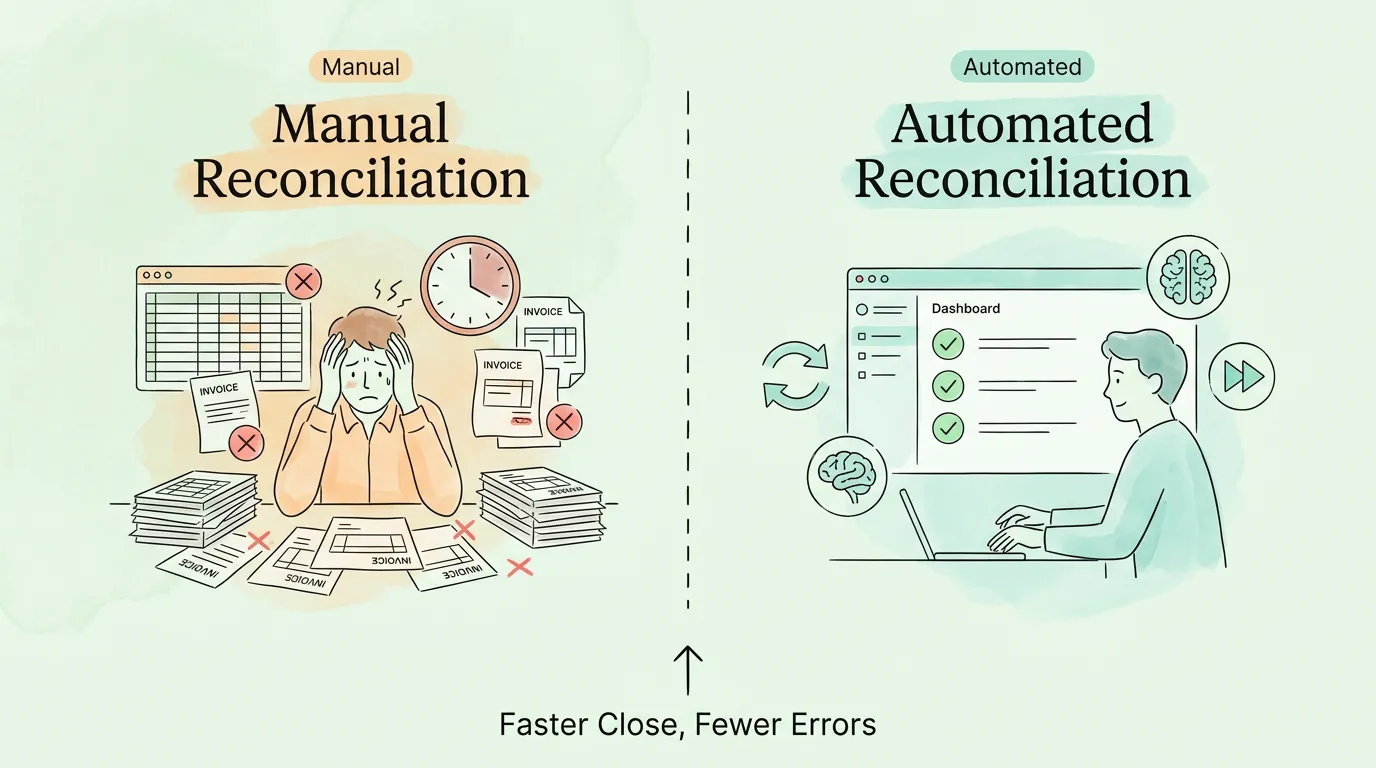
A manual balance sheet reconciliation checklist depends on each step being initiated, tracked, and completed by individuals. When someone is sick, overwhelmed, or simply forgets a step, the checklist breaks. Automation addresses the structural weakness: it eliminates the dependency on individual memory and manual coordination for the mechanical parts of the process.
The automation opportunities are different at each step:
Cash: Bank feed integration automatically imports transactions and suggests matches in near real-time. Instead of a once-a-month reconciliation of hundreds of transactions, the team reviews a daily exception list of unmatched items. See our guide on accounting automation software for what bank feed automation looks like in practice.
Accounts payable: Automated invoice capture (from email inboxes and vendor portals), AI-powered data extraction, and three-way matching logic eliminates most manual AP data entry and catches discrepancies before invoices are approved for payment. This dramatically reduces the AP completeness testing burden at month-end because the controls are operating continuously. For a detailed breakdown, see automate accounts payable.
Invoice and receipt reconciliation: AI-powered OCR captures every invoice and receipt automatically, extracts key fields, and matches them to purchase orders and bank transactions. The reconciliation work that used to happen manually at month-end happens continuously as documents arrive. See how to reconcile invoices for a practical guide to this process.
Depreciation and prepaid amortization: Accounting software with fixed asset modules and prepaid schedules calculates and posts these entries automatically each period, eliminating a significant category of manual journal entry work.
Reporting: Automated reconciliation platforms produce period-end reconciliation packs — standardized documentation for each account showing opening balance, movements, closing balance, and reconciling items — that can be reviewed and approved in the system rather than assembled manually from spreadsheets.
The result of automating the mechanical steps is that your finance team's month-end work shifts from data gathering and entry to review and analysis — the work that actually requires human judgment. For a broader look at how accounting process automation changes the finance function, see accounting process automation and accounting workflow management.
Self-Assessment: How Mature Is Your Reconciliation Process?
Rate your current process on each dimension from 1 (not in place) to 5 (fully implemented and consistently applied).
Dimension
1 — Not in place
3 — Partial
5 — Fully implemented
Your Score
Coverage
Several balance sheet accounts not reconciled
Most accounts reconciled; a few gaps
Every balance sheet account reconciled monthly
External verification
Reconciliation is only internal (GL to sub-ledger)
Cash and AP verified externally; others internal only
All major accounts verified against external sources
Documentation
Reconciliations exist in preparer's head or informal notes
Reconciliations documented but not standardized
Standardized reconciliation packs for each account
Independent review
Preparer reviews their own work
Senior reviews some accounts
All reconciliations reviewed by someone other than preparer
Cut-off consistency
Inconsistent; varies by preparer
Documented policy; not always applied
Consistent cut-off policy applied every period
Timely resolution of items
Items carried forward without resolution
Most items resolved within 60 days
All items resolved within 30 days or escalated
Automation
Fully manual
Bank feeds automated; rest manual
Most repetitive steps automated
Close timeline
Month-end close takes 10+ business days
5–8 business days
Under 5 business days
Score interpretation:
32–40: High maturity. Focus on optimizing the automation layer and reducing close time.
20–31: Functional but inconsistent. Prioritize documentation, independent review, and cut-off consistency.
10–19: Significant gaps. Start by ensuring every account is reconciled and documented, then add controls.
Under 10: Foundational work needed. Engage an external accountant to establish a baseline reconciliation process.
Frequently Asked Questions
What is a balance sheet reconciliation checklist?
A balance sheet reconciliation checklist is a structured list of verification steps that confirm every account on the balance sheet is accurate, complete, and supported by documentation. It covers all asset, liability, and equity accounts — from cash and accounts receivable to debt, accrued liabilities, and retained earnings. The checklist ensures that the closing balance in each account matches its corresponding external record (bank statement, vendor statement, loan amortization, physical count), that timing differences are identified and documented, and that any discrepancies are investigated and resolved before financial statements are issued.
How often should a balance sheet be reconciled?
The recommended frequency depends on the account and the business's risk profile. Cash accounts should be reconciled daily or weekly given the fraud and liquidity risk. Accounts receivable, accounts payable, accrued liabilities, debt, and equity should be reconciled monthly as part of the month-end close. Inventory should be reconciled monthly using a perpetual system, with cycle counts covering all items at least once per quarter. Fixed assets require monthly depreciation validation and at least an annual physical verification of major asset categories. For businesses preparing audited financial statements, all accounts require formal monthly reconciliation.
What is the difference between bank reconciliation and balance sheet reconciliation?
Bank reconciliation is one specific step within balance sheet reconciliation. It verifies the cash and bank account balances specifically, matching the GL balance to the bank statement and explaining differences like outstanding checks and deposits in transit. Balance sheet reconciliation is the broader process that covers all accounts on the balance sheet — cash, receivables, prepaid expenses, inventory, fixed assets, payables, accrued liabilities, debt, and equity. A complete balance sheet reconciliation includes bank reconciliation as its first step.
What are the most common balance sheet reconciliation errors?
The most common errors are: (1) reconciling only to internal records rather than external sources, which confirms consistency but not accuracy; (2) carrying unexplained reconciling items forward from period to period without investigation; (3) inconsistent cut-off treatment, where the same type of transaction is handled differently in different periods; (4) the preparer reviewing their own reconciliation without independent review; (5) inadequate allowance for doubtful accounts that overstates AR; (6) unrecorded accrued liabilities that understate expenses and obligations; and (7) misclassification of debt between current and long-term.
How long should a month-end balance sheet reconciliation take?
For a small business with straightforward transactions and good automation, a complete month-end close including all reconciliations should take two to four business days. For a mid-size company with more complex accounts, five to seven business days is typical. For large enterprises, three to five business days is achievable with good workflow and automation. The main drivers of a slow close are: manual data gathering (solved by bank feeds and automated invoice capture), lack of standardized reconciliation templates (solved by documented processes), and sequential rather than parallel work (solved by assigning account ownership so multiple accounts are reconciled simultaneously).
How does automation improve balance sheet reconciliation?
Automation improves reconciliation in three ways. First, it eliminates manual data entry — bank feeds, automated invoice capture, and direct API connections to vendor systems mean data is already in the accounting system rather than being keyed in. This removes the most error-prone step. Second, it accelerates matching — automated three-way matching, bank transaction matching, and AR payment application happen in real time rather than at month-end, so the reconciliation workload is distributed across the month rather than concentrated in the last three days. Third, it produces standardized documentation — reconciliation packs, exception reports, and audit trails are generated by the system rather than assembled manually from spreadsheets. For a practical overview of the tools involved, see accounting automation software.
What documentation should be retained for each balance sheet reconciliation?
For each account reconciled, you should retain: the reconciliation schedule showing opening balance, period transactions, closing balance, and reconciling items; the external source document (bank statement, vendor statement, loan confirmation) that was matched against; a log of all reconciling items with their explanations and expected resolution dates; evidence of independent review (reviewer signature or system approval log); and the journal entries that resulted from the reconciliation. This documentation should be stored in an organized, retrievable format — not in individual spreadsheets on personal desktops. Retention periods should follow your jurisdiction's requirements; in the US, financial records supporting tax filings should generally be retained for seven years per IRS guidance on record retention.
How Do You Turn a Checklist Into a Reliable Close Process?
A balance sheet reconciliation checklist is not the goal — financial accuracy is. The checklist is the mechanism that reliably produces that accuracy period after period, regardless of who is doing the work or how busy the period was.
The finance teams that close fastest and with the fewest errors are not the ones who work harder at month-end. They are the ones who have built systems — standardized templates, clear account ownership, automated data capture, consistent cut-off policies, and independent review — that make accurate reconciliation the path of least resistance. Month-end becomes a review and sign-off on work that has been happening continuously, not a scramble to reconstruct what occurred.
TallyScan automates the invoice and receipt capture that feeds your AP reconciliation — pulling documents from email and vendor portals, extracting key fields with AI-powered OCR, matching to purchase orders, and syncing approved data to your accounting platform. The AP side of your balance sheet reconciliation stays current without manual data entry.